


Light of Alariya is a 3rd person, open-world puzzle game where the player must explore a vast desert in a magic boat and search for long-forgotten ruins of a buried world. There the player will seek to restore the power of the stars and awaken their sleeping civilization.


Quest Designer
As a quest designer on this project, I was responsible for handling the main plot of the game, as well as writing over 70 percent of the dialogue shown in game.
In addition, I was responsible for the quest progression system that drives the main game forward.

As development progressed the story of the game became driven by the technical capabilities and scope of the project.
The original story had nothing to do with a goddess or the stars, but was about recovering artifacts to build a machine.
When most of our NPCs were cut, the story had to justify that choice, so the quest to awaken a sleeping population was born from that requirement.
It was a unique mix of creative writing and puzzle solving that I hadn't experienced before
My scripting skills came in handy during this process. I worked with programmers to create a flag-based progression system to keep track of player actions.
Making the system robust enough for an open-world game was a challenge, since the player can approach objectives from almost any angle, in many orders.
We were also able to repurpose this system to keep track of collectibles, which let us keep in the optional collectibles feature, which would have otherwise been cut.
Open World Designer
As an open world designer, I was given responsibility over 1/3 of the open world. Namely, I helmed the creation of the red sands area and all of the open world points of interest in that region.


The Red Sands
The layout of the red sands was one of the first things I did in this project.
To give it a unique identity, I created an area filled with canyons and mesas.
The canyons formed a simple maze of sorts, and at nearly every exit the player would find a point of interest
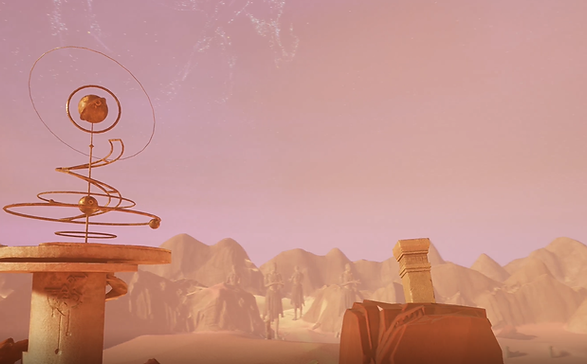
Ruby Observatoy
I created the idea of using observatories as waypoint towers that would reveal more of the map.
Each observatory contains a platforming challenge, and reaching the top will reward the player with a view, and directions to the points of interest in the region.
The challenge of the red observatory is to traverse towering rock pillars to climb up a broken spiral staircase.

The first design I submitted for the observatory tower
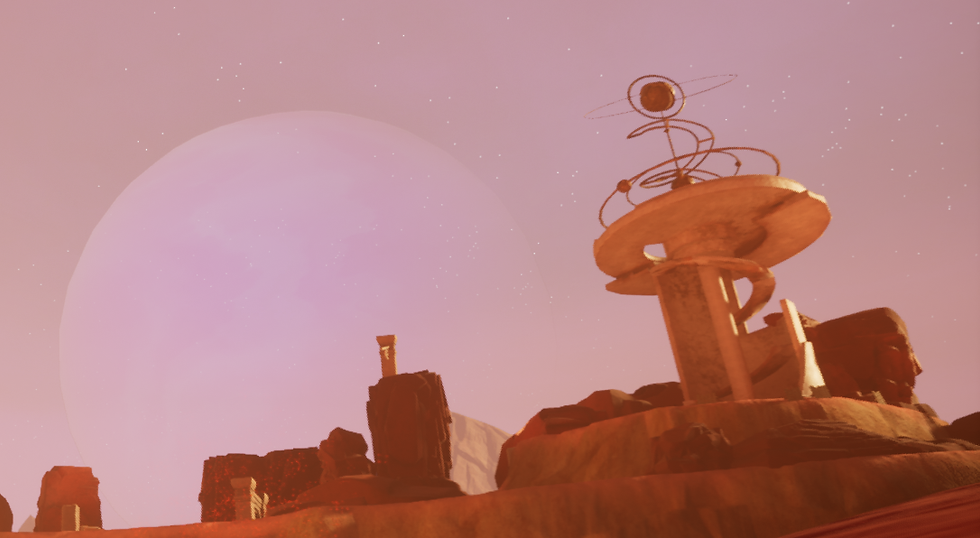
The in-game version of the ruby observatory
The first design I submitted for the observatory tower

The original cliffside village

The in-game version of the collapsed bridge
The original cliffside village
Storm's Sanctuary
This location was originally a village embedded into the sides of a canyon.
Through iteration, it became a derelict bridge that the player will need to cross.
One challenge with designing this area was creating a platforming challenge that was difficult but not punishing.
Falling off the bridge would mean a long trip back up, so I tried to minimize those falls by making larger landing zones and generous swing points.
Jewels of Ke-Maut
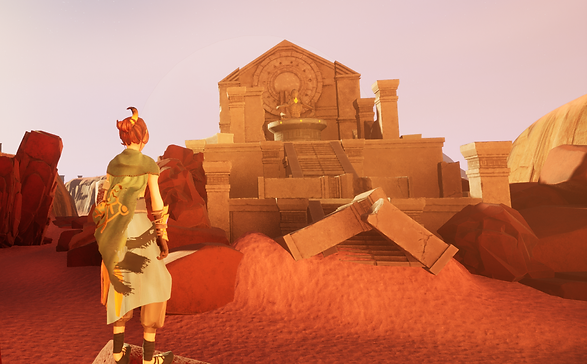
What originally started as a mine turned into a large unearthed temple.
My goal with this area was making the area fun to traverse while still keeping the natural feel of the temple.
Using some well-placed collapsed pillars, I was able to turn a seemingly simple area into a puzzle to reach the top of the staircase.
Riftside Bluffs
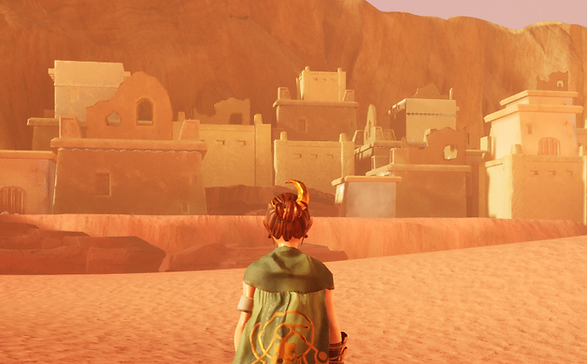
This area was designed more as a storytelling piece than a puzzle.
I reused several assets from the main town of the game to show the progression of the civilization over time.
Rather than including a puzzle, the player is encouraged to explore the abandoned village and find things left behind in the wreckage.
Retrospective
What Went Well
-
Open world framework: We were able to understand and build an open world very early on, which let us create an even more in-depth world.
-
Designer Communication: With everyone working in the same "level" for the entire project, we were concerned about stepping on toes or overwriting work. We prioritized communication and managed to minimize any overlap and worked quite efficiently.
-
Adaptability: Both on in-game areas and in narrative, I was able to quickly adapt and change my content as the scope and scale of the game changed over the course of the project.
What Went Wrong
-
Established pipelines: Some content pipelines were not as developed as they should have been, which slowed workflow for asset creation significantly.
-
Cut Content: The game we did ship is very impressive, but there were a lot of features that ended up getting cut. Some of these features likely could have been preserved with better planning.
-
World Planning: There were several areas in the game that did not have a clear purpose or aesthetic direction until late into the project. With better world planning, these areas could have been better fleshed out.
What was Learned
-
Cross discipline communication: Make sure there are clear pipelines between all disciplines, so any feature for the game has a clear path to implementation.
-
Repurposing Content: Even with some heavy cuts, we were able to repurpose areas and redesign features to make everything we could make the best it could be.
-
Planning and Game Identity: Even if every feature is not fully designed at the start of development, it is imperative that everyone on the team has a strong idea of the game's identity.