


“Rooftop Rumble” is a custom side quest mod for Dying Light. The player enters into a deadly gladiatorial tournament set up by maniacal bandit leader Rais for a chance to win life-saving medicine for their settlement. To win, the player must battle other competitors, zombies, and Rais’s own personal guard across collapsing apartments, treacherous scaffolding, and precarious rooftops. Try not to fall.
Design Objectives
Circular Combat Flow
In making areas for high-intensity combat, the arena should naturally guide the player around it, so the player can always stay on the move.
Differing Arena Styles
Different enemy types have different strengths and weaknesses. These features are highlighted by building arenas to support or hinder those features.
Open-Ended Combat
Dying Light offers many ways to approach a fight, and perceptive players will be able to adapt to the area around them to get an edge in the fight.
Circular Combat Flow

Combat arenas must have good movement flow. The player should be focused on the enemies first.
Any environmental flow should serve the player in moving toward or avoiding enemies, and should never hinder the player's movement.
The key to good flow in combat is incorporating loops into the play space with cover or environmental objects.
The player always has a place to move next, regardless of where they are. Fully turning around should be avoided.


Minor and major loops are key for keeping areas interesting.
Each arena has a major loop to move between each sub-area.
Each sub-area also includes one or more minor loops to encourage flow.

Arena Styles

I wanted each arena to have a different aesthetic style, as well as focus on a different combat style.
The first arena is inside a destroyed apartment complex. Walls and ceilings have been knocked down to convert the space into an arena.

The focus of the first arena is horizontal combat, since the whole arena is on a single floor.
Players must rely on dodging sliding, and vaulting to evade enemies.
The flatter terrain and simpler enemies help serve as a tutorial for challenges later on.
The second arena is a construction site on a skyscraper, filled with scaffolding and abandoned equipment.
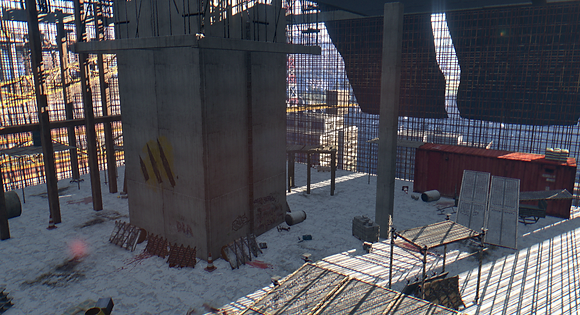
This arena's focus is on movement and verticality.
Fast zombies chase the player. Ramps and beams allow quick movement between areas and layers.
The player can move constantly on the upper or lower layer, or switch between them at any time.


The final arena is on a crumbling rooftop.
There are no rails or ledges, and ranged enemies are set up to rain fire on the player.

The focus on this arena is juggling ranged and melee enemies, as well as environmental hazards.
The constant threat of falling is ever present, and the player will need to make some death-defying jumps to survive.
Open-Ended Combat
Dying Light's movement and combat mechanics allow players to approach encounters in a variety of ways.
It is possible to beat any encounter by just running up to and fighting each enemy, but creative players can use the world to their advantage.
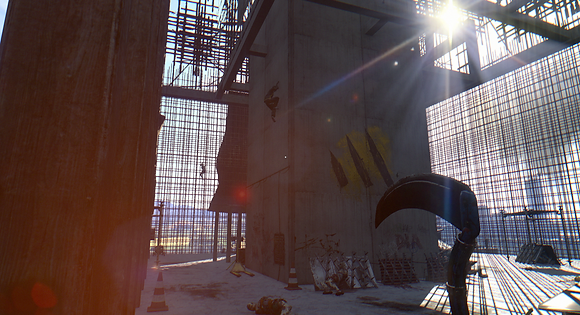

In the first arena, players can use narrow passageways or doors to bottleneck enemies and trip them with a slide.
The second and third arenas have several traps lying around. Kicking or bumping enemies into them can be a quick way to take them out while on the move.

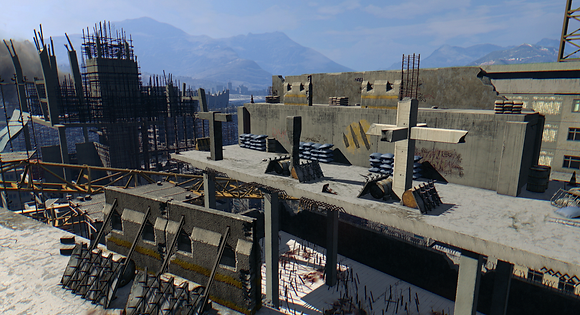
The final arena has precarious edges, leaving room to kick enemies straight off the building.
The boss of the map will charge the player, and clever players can trick them into falling off the side.

Retrospective
What Went Well
-
Varied Combat Design- My intent with this project was to explore different combat styles with different arenas. I feel that each arena had a strong identity, and supported its own combat style.
-
Planning and Scope- I identified a good size for my level and tested it early on, so not many pivots were needed. The modular style of the arenas also meant that pivots were often on a much smaller scale
-
Unique Enemy AI- I wanted to support each of my arenas with enemies that could take advantage of it. By scripting enemies to take advantage of the environment and using some clever tricks to spawn in enemies, the world felt much more alive.
What Went Wrong
-
World Scale- My level takes place on tall skyscrapers, so there were incredibly long sightlines that needed to be covered. I spent quite a long time building a background cityscape.
-
Realism vs. Game- Many of the transitional areas between arenas involve jumping across scaffolding. I struggled making these areas look semi-realistic, while still making the platforming a fun, interesting experience.
-
Boss Balancing- To preserve the challenge of the rest of the level, the player was not well-equipped to take on the boss head on, making it much harder to fight. They can trick the boss to fall of the edge, which makes it quite easy. Ideally the fight would have fit in a sweet spot between the two experiences
What Was Learned?
-
Match Environment to Enemies- Most enemies in most games have some unique quirk. Building environments to take advantage of those quirks for benefit or challenge makes the world feel alive, and fights more interesting.
-
Resources vs Skill- Giving players adequate resources to face a challenge is a necessity, but simply giving them more resources to face harder challenges may not work. The player's skill level must also be curated and brought up to match the challenge.
-
AI Scripting- Beyond more theoretical design lessons, I learned a lot of technical knowledge in scripting the enemies in this quest, and how they interact with navmesh, environment pieces, and other AI in the level.
Maps


Gallery


