


"Unstoppable” is a custom side quest mod for Fallout 4, in which the player discovers a settlement under the protection of people under the guise of a superhero team called the Unstoppables. However, when the player arrives the town is in the midst of a betrayal, as one of the members of the superhero team supposedly turns on the rest. So, it is up to the player to travel with the last surviving member of the Unstoppables to find out what truly happened, and pass judgement on the perpetrator.

Maps


Design Objectives
Meaningful Choice
Pacing the story and balancing both sides of the narrative to create a difficult choice for the player that has impact on the world.
Creative Use of 3D Space
Making use of every part of the world to both tell a story and to best lead the player through the world organically
Supporting Multiple Playstyles
There are many different ways to play Fallout 4, and I wanted to support as many of those playstyles as I could
Meaningful Choice
To help pace the narrative of the quest, I relied heavily on the player's companion character, The Mistress of Mystery.
Since she travels with the player, she can help provide relevant context and comments to plot-heavy moments.
Plus, it helps with immersion, as the player will be discovering information alongside their companion.


I also introduced my villain early on, and had her speak to the character over an intercom at various points.
This allowed me to break up combat sequences with story beats.
This also let me give more information about her character without face-to-face interaction, since that could end in combat.
To satisfy the explorers playing my quest, I dropped several pieces of lore on terminals in the play space.
Reading them helps give context or backstory to the people or places surrounding the quest.
The companion character will also comment on these lore entries, since she will be discovering them with the player.

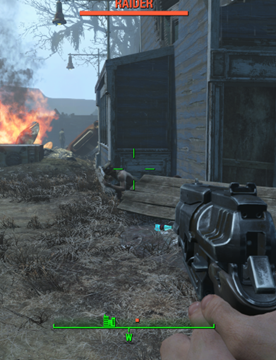
In one ending of the game the town is attacked by raiders.

In another ending the town is left defenseless and a ghoul attack occurs.
In one ending of the game the town is attacked by raiders.
To show the weight of the player's choices, certain characters may live or die, and some combat encounters will be completely different.
Supporting one character in the quest will enrage a group of raiders who will attack the town.
Another choice could leave the town defenseless against ghouls or other monsters.
Three-Dimensional Playspace
When the player first arrives, they are met with a small settlement that has been thrown into chaos.
All the while a massive lab looms over the space, framing the goal and supporting the narrative that something much bigger is happening behind the scenes.
Upon entry, leading lines point to the main town square, where an NPC is waiting for the player.

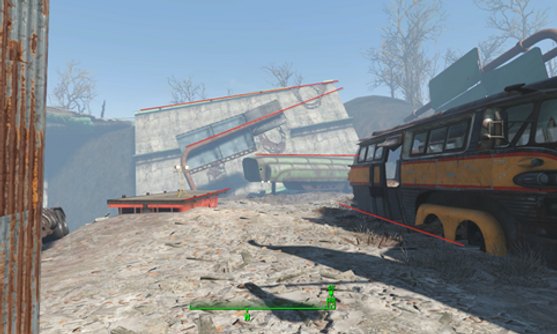
In the exterior space, rubble paths, abandoned vehicles, and broken signs all point to the large biotech lab.
Fallout does provide objective markers, but ideally these lines would lead the player even without any HUD
The interior space is essentially a large circle the player must navigate to find a functional stairwell to get upstairs.
In nearly every room the player can find a sealed entrance or broken path reminding them of their goal.


When walking into any room, I wanted the player to know the most important things about that room.
I used brighter lights to signify exits or highlighting people to talk to.
To show side paths or hidden exits, I made sure the rooms had enough color contrast so the exit would be noticed.
Multiple Playstyles
Making every encounter perfectly suited to every single playstyle is nearly impossible, so I tailored each combat zone to be best suited to one or two specific playstyles, to allow players that had invested into their playstyle to flex their skills.
The exterior area is designed for those that prefer long range combat.
Enemies patrol on elevated walls, leaving opportunities for sniping.
A provided snipers nest allows players to safely take out foes from a distance at a vantage point.


Some interior rooms are smaller, encouraging close quarters combat with melee or shotguns.
No enemy will be far from sight, but that also means that enemies can rush down the player.
Creating circular flow and loops, even in these small spaces was important to facilitate fun combat.
Larger interior rooms have great opportunities for stealth.
Patrolling enemies and smaller sub-chambers let sneaky players move in between rooms while staying out of sight.
Players can try to pick off enemies one by one or avoid them all entirely by slipping through unseen.

Retrospective
What Went Well
What Went Wrong
What Was Learned?
-
Scope/Scale: I was able to quickly iterate on my overall design early on, which allowed me to adjust the scope of the quest before I even started building.
-
Narrative- I pride myself on being a good writer, and I was able to flex that skill to create a compelling story where either side of the conflict could reasonably be picked.
-
Planning and time management: I was able to plan out my milestones by breaking work into smaller, bite sized tasks that felt less daunting to start, so I was able to chip away at work over time, rather than trying to do it all at once.
-
Seeking help and feedback: I would often spend too much time trying to solve a problem or refine a feature on my own rather than asking for help or direction from my peers or stakeholders, which could have saved a lot of time and stress.
-
Difficulty scaling- I had some trouble balancing the level to be challenging, but also completable. I leaned more on the easier side, fearing making the level too hard, but I fear I never really found that sweet spot in the middle.
-
NPC Scripting- As this was my first time working with creation kit, bugs were expected, but attempting to get NPCs to do so many complex things ate up a lot of development time.
-
Taking feedback: Over my time as a designer, I have gotten better at not taking harsh feedback personally, and at filtering through long swaths of feedback to find the meaningful advice that can help improve my work.
-
Balance testing- Testing player abilities and weapons against designed challenges consistently can help make a satisfying, challenging experience
-
Gated encounters- When attempting to script an NPC to perform complex actions, it is difficult to predict where the player will be, so the NPC reaction can be unpredictable. Creatively using gates, doors and loading zones can give more control in these moments.
Gallery


