
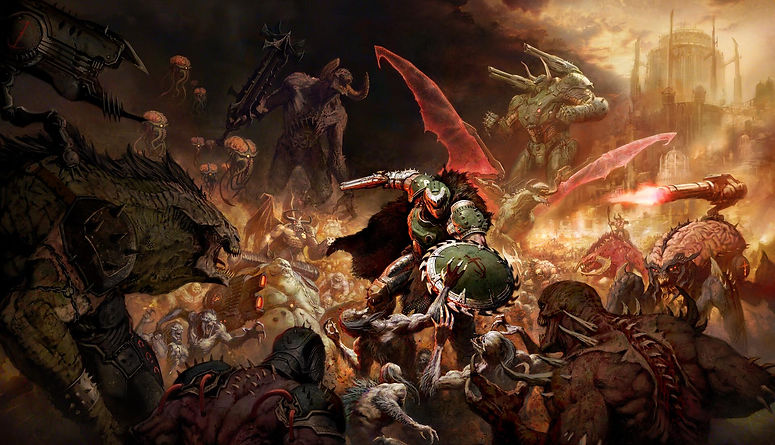

*not everything shown in the trailer is my work
_edited.jpg)
Combat Responsibilities
On Doom: The Dark Ages, I was responsible for the gameplay and combat in 7 of the 22-level campaign
-
Hebeth
-
Barrier Core
-
The Forsaken Plains
-
Hellbreaker
-
City of Ry'uul
-
The Kar'Thul Marshes
-
Reckoning
In designing a combat space for Dark Ages, there was a lot to consider for each one, since there were a few different types of encounters that would fundamentally change how the space would be built
For large, main objective fights, the two types of combat spaces I built were arenas and morale fights
Arena Design

Arenas
Arenas are spaces built for the more typical, wave-based fights that many FPS games are known for.
In my arena designs, I often built the space with specific enemies in mind that I could use as headliners in the fight. That way, when building the paths, sightlines and terrain, I could keep those headliners in mind so the space would accommodate them particularly well.

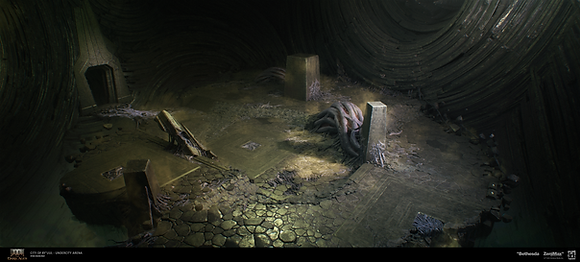
For example, I designed this arena found in the Kar'Thul Marshes. This the last space the player fights in during the level, so the fight had to be meaningful. I designed this space with the komodo enemy in mind: a huge lizard enemy that runs the player down with constant pressure.
The space is relatively flat with only slight changes in elevation. The intent behind this was so the player could always see just how far away the komodo was at any given time. Plus, since the komodo is exceptionally large and fast, it works well in horizontal spaces where it can charge the player. I didn't want the player to be able to find a vantage point and be able to safely take on the komodo, I wanted it to be a constant threat.
Once the arena was actually built, I constructed the rest of the combat encounter. Naturally, the komodo is the star of the show, and some of the encounter design was dedicated to pairing it with other enemies that would support its high-pressure moveset, like the Acolyte: a teleporting enemy that drops projectiles onto the player from afar. The acolyte provides a nasty distraction while attempting to run away from or focus on the komodo. From there I like to build out the encounter, considering the abilities and strengths of certain enemies in the space, all the while considering pacing out the experience to lead up to the finale I had planned from the very start.
Morale Spaces
Morale Spaces are combat zones more unique to Dark Ages, where a shielded leader demon is spawned from the first moment, and the player must take down support enemies before they can damage the leader and end the encounter
Morale spaces are built to have the player carve a path through them and chip away at a massive army, rather than have them bounce back and forth across the space like arenas.
Having one key enemy constantly present worked well with my arena design philosophy, but knowing the player could never engage with them until the end of the fight was a challenge.

_edited.jpg)
An invulnerable enemy present at all times means they could potentially always attack the player with no recourse, which is rarely ever fun.
Designing morale spaces means providing enough line of sight blockers so the player has space to fight outside of the leader's range, but also enough open space so the leader can effectively be an environmental hazard until they can be engaged.
Combat Flow
Outside of the actual combat spaces, much work goes into the combat flow, and directing the player to where I want them to be at certain points in the fight. This is achieved in a few ways:
-
Enemy Pods: Subdividing arenas and spawning in pods of enemies to form their own "mini encounter" is an easy way to lead the player to segments of an arena during key points
-
Priority Targets: Certain enemies are particularly dangerous if left alone. Spawning these enemies and limiting where they can move pulls the player toward that space almost subconsciously
-
Distracting Targets: Sometimes in larger combats the player will be left fighting a tanky enemy nearly solo. To prevent this from getting boring or too easy, I often spawn in distracting pressure units or enemies to shoot from the periphery to distract the player, and give them one extra thing to juggle while taking on their main target.
_edited.jpg)
_edited.jpg)
_edited.jpg)
Combat Pacing
Pacing combat is a key element of ensuring a fight, and the entire level, feels fun and exciting the entire time.
Within an individual fight, I like to structure it like a multi-act play. Whether that play is 3 or 5 acts, I try to ebb and flow the quantity of enemies and intensity of the challenge to make the fight feel dynamic, yet still challenging.
Across an entire level, I have to be aware of using the same enemy type too often, lest it get repetitious. Also, I have to consider how many heavy fights (or lack thereof) I'm putting the player through in succession. There were several large fights I had to tone back to a single wave or incidental encounter for the sake of helping the pace of the rest of the level.

Enemy Variants
I was also responsible for the creation of several armored enemies and their unique attack patterns.
The armored arachnotron fires arrows and walls of projectiles that move in wave patterns, which is quite different from its unarmored counterpart, who only fires hitscan at a distance.
Since this variant was armored, it felt a bit unfair to give him an instant attack that couldn't be interrupted right away, so we opted for projectiles that still kept their agile, dodgy nature.
I also designed the armored mancubus, a tanky enemy that serves to block the player's path and fires walls of projectiles that block player shots
As the player gets more powerful over the campaign, the base mancubus became less effective at actually slowing down the player. Naturally, having armor helps with this.
The wall attacks force the player to either disengage with the enemy entirely, or weave through the projectiles to get right to him. It created a very satisfying risk/reward moment when facing him down.


Puzzle Mechanics
I designed the wolf statue puzzle mechanic that is used in several levels across Dark Ages' campaign
The player must seek out and destroy several wolf statues in an area to cause golden versions of them to appear and unlock an area, usually a major secret.
I designed this with simplicity and versatility in mind, so that it could be used anywhere, and I'm glad to see that it found a home in 4 different maps.